%20(2)%20ajustado.png)
The gracious delicacy of the Crême brûlée
- Any Persiani

- Feb 1, 2022
- 3 min read
Updated: Feb 2, 2022
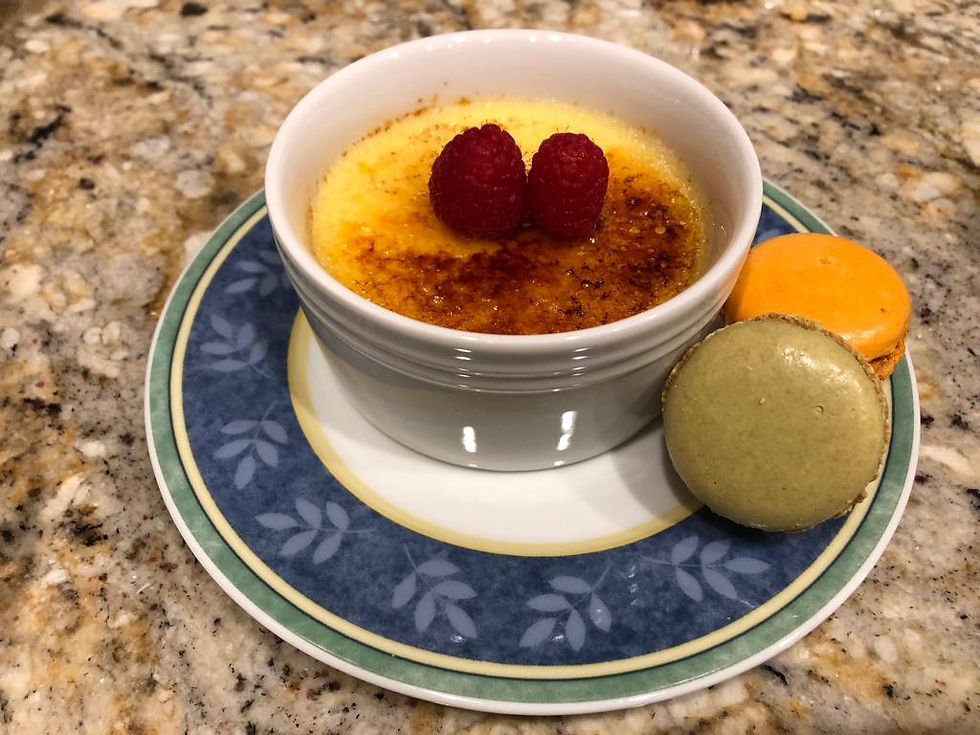
This dessert, literally translated from French as burned cream, is a cream made from milk, eggs, sugar, and vanilla. Crême brûlée involves several stages in its preparation. The ingredients are first mixed and cooked, then baked and finished with burnt sugar to form a thin, crunchy layer of caramel.
It is believed that it was in the seventeenth century when François Massialot collected recipes from different regions and recovered among them the recipe for Crema Catalana. Tradition has it that little Philippe d' Orléans liked to go into the kitchen from time to time and that on one occasion he complained to François Massalot, his cook, that the custard was getting cold. To fix the problem, the chef came up with the idea of placing a red-hot griddle on top of the sugar layer of the custard. The sugar caramelized but the custard did not heat up. The contrast between the hot and cold and between the crunchy texture of the sugar and the creamy texture of the custard pleased the prince so much that he popularized the recipe at his court.
Despite the name, some believe that the custard originated in English cuisine and that today we know the name because of its popularity in France. Other experts believe instead that it is a French adaptation of the recipe for crema catalana quemada, which was also made in French Catalonia and the Languedoc region.
Whatever the case, it is a gastronomic delight that is very easy to prepare and that anyone can make at home.
The custard came out very nicely, with a good texture and delicious flavor and the caramelizing of the custard was also good from my view. I was afraid of the torch, as I had never used one before, but it worked out very well. The flame is not as bad as I thought.

I had fun making this dessert which does require attention to detail to succeed.
The main technique used here for baked custards is tempering the eggs, which means that when your heavy cream and any extract of your choice (vanilla for the original recipe) is just at a scald (almost but not boiling) in the saucepan, you add the liquid to your mixed yolks and sugar (you do not want the eggs to coagulate) and whisk well to combine.
Another tip is to strain the mixture once done, to make sure you get a soft and velvety consistency. Finally, to bake your custard, make sure to place your ramekins on top of a sheet pan with hot water around them to at least half of your ramekins, to make sure they are cooked evenly.
The main challenge I faced was using the torch since I had never used one before. I practiced beforehand to make sure I would not burn the caramel too much. Thankfully, it was easier than expected.
Another aspect to consider is flavor combinations when it comes to decorating (if you wish) your final creme brulee. Once I caramelized one of the custards, I tried different decorations and I used kiwi as one of them because I thought it looked very nice and it does. However, as I ate the cream, I noticed that the juicy consistency of the fruit mixed with the cream does not go as well in the mouth; therefore, I do not believe I would use much of it in the future.
I later tried adding a raspberry macaron and the combination was great. It was a nice kick of the raspberry with the delicacy of the crème brulée.

Either when preparing your custard or if you want to add some decoration at the end, you can add different flavors that will give your dessert a different kick and that is what will make it unique!


Comments